Credentials without borders: ITCILO’s digital revolution

For more than 60 years, the International Training Centre of the ILO (ITCILO) has been training hundreds of thousands of learners from all around the world. Traditionally, the Centre was issuing paper certificates for its in-person courses, and PDF certificates for its online courses. Those were costly to print and ship, slow to verify and easy to lose or misplace. They required significant manual intervention, and occupied considerable physical archiving space; verifying an old credential meant receiving numerous phone calls and emails, and scanning through those archives. Mailing physical certificates to thousands of learners grew costly and unpredictable as courses went global – paper and PDFs were also vulnerable to forgery, with authenticity hinging on signatures and labor-intensive cross-checks.
Since the COVID-19 pandemic, the ITCILO has evolved into a centre of excellence for training and capacity-building. With its rapid adoption of digital delivery models, including AI and virtual reality-enhanced learning, the Centre was no longer confined to providing training in traditional formats. The onset of the pandemic revealed the limitations of the traditional certification model when face-to-face courses were suspended and learners had to return to their home countries before completing their courses or receiving their certificates. At that point, ITCILO needed an immediate remote, scalable way to issue and verify achievements – fast, secure and fit for a digital-first world.
An Ethereum-based solution for credentials
Out of this urgency, ITCILO turned to digital credentials backed by blockchain. In mid-2020, the team began exploring options beyond PDFs. After surveying various providers, the centre chose a cloud service (Accredible) that issues verifiable digital certificates and badges anchored on the Ethereum blockchain. In just four months the Centre made a permanent switch to digital credentials as part of its broader digital transformation.
Why blockchain? For ITCILO, Ethereum’s public blockchain offered a decentralised, tamper-proof ledger to validate certificates. Each credential issued is cryptographically hashed and recorded on Ethereum’s mainnet. This means any viewer – whether an employer or partner institution – can click a “Verify” button on a certificate’s webpage to confirm its legitimacy against the record.
“As a reputable UN Organization, the logos and signatures on our certificates, in addition to the credential itself hold great value. The blockchain feature brilliantly helped us ensure the security aspect,” explains Eiman Elmasry, a Quality Assurance and Data Analytics Officer at ITCILO. “These certificates cannot be faked or altered”. Indeed, once a credential is on-chain, it cannot be forged; any attempt to create a look-alike certificate would fail to verify against the authentic blockchain entry. This public verifiability instills trust and reassures stakeholders that an ITCILO certificate is genuine and earned, not just a PDF someone doctored.
Equally important, the blockchain is used behind the scenes and learners do not need any crypto wallets or technical know-how. They simply receive an email with a link to their credential, which they can also access directly via the ITCILO Online Campus. The heavy lifting – writing the hash to Ethereum and managing transaction fees – is handled by the platform, with ITCILO staff initiating the issuance. By keeping the technology invisible in the background, the centre hid the crypto complexity while leveraging its benefits. From the learners’ perspective, their digital credential is just a click away, shareable online and printable on demand, but now with an added layer of authenticity.
Measuring success and verifying impact
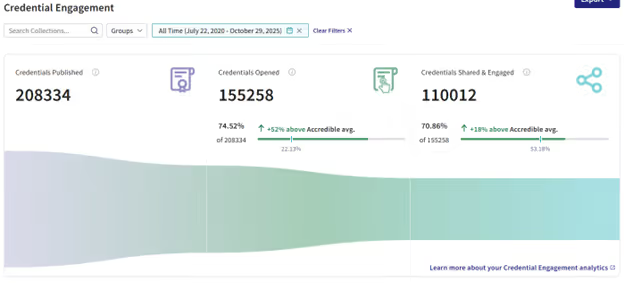
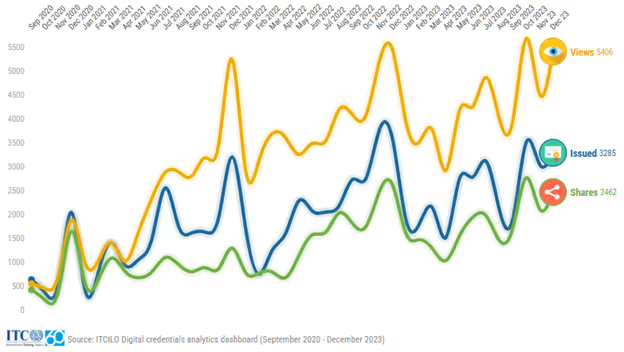
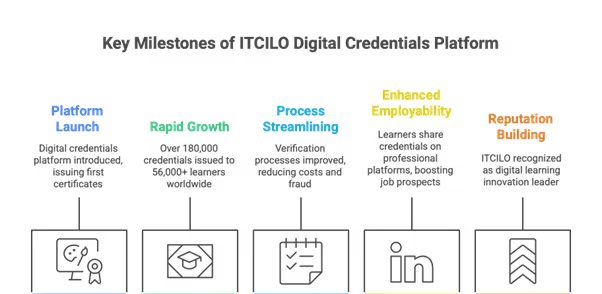
Adopting innovative tech is one thing, proving its value is another. ITCILO implemented a robust monitoring and evaluation framework to assess the results of its digital credentials initiative. At the output level, the team tracks metrics like the number of credentials issued and how often they are shared or viewed. The response has been overwhelming; by October 2025, over 208,000 blockchain-secured credentials had been issued to almost 101,000 individuals. Learners enthusiastically shared these credentials upwards of 95,000 times on social media, amplifying ITCILO’s reach. Each share is a tiny vote of confidence and an indicator that participants find value in showcasing their ITCILO badges and certificates.
To gauge outcomes beyond issuance counts, the centre folded the credential rollout into its annual external evaluations of training impact. It uses a comprehensive evaluation methodology to measure training results on five levels of the Results-based Management Framework – from activities delivered, to immediate reactions to how learning is applied on the job. External evaluators gather data through desk reviews, participant surveys, focus groups and interviews. One key indicator is the rate at which knowledge is applied in the workplace. Recent evaluations found that around 73% of participants were able to provide examples of how they had applied new knowledge in their jobs after training. This signals that ITCILO courses – now complemented by digital credentials – are actively used to improve work practices.
Crucially, verification and transparency are baked into the system. Each credential’s public page displays its details and on-chain verification; employers and partners can validate with a click. The ledger serves as a public audit trail, turning course completion from an internal note into a verifiable fact. ITCILO also publishes progress updates and makes evaluation reports publicly available, inviting scrutiny.
Real-world results and human impact
Five years into this digital credential journey, the gains are concrete. Staff no longer chase paper trails and can focus on higher-value work; postage and fraud-prevention costs have dropped; and thousands of sheets of paper and international shipments have been avoided – an efficiency win that also aligns with UN sustainability goals.
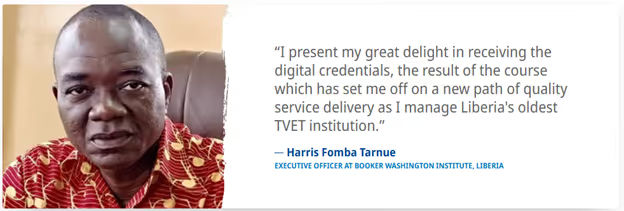
The change is most visible on the learner side. With credentials that are secure, portable, and instantly verifiable, participants showcase their training with confidence. “By adding this credential to my CV and LinkedIn profile, I become more eligible in various positions. It will bolster my chances of advancing my career,” says Leo Long of South Africa. Other learners echoed the recipient’s delight, pride and appreciation.
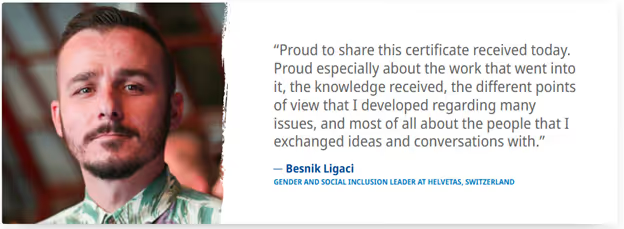
As graduates congratulate one another and share badges, a global peer network has taken shape. To sustain that momentum, ITCILO launched an alumni platform anchored by a digital “Alumni” badge, extending access to forums, collaboration, and continued learning.
The transition to digital credentials wasn’t as challenging as expected. As with any digital transformation initiative, staff and recipients needed onboarding to the platform; governance on how to issue credentials had to be clarified, API integration with the online learning platform had to be established. However, since all stakeholders perceived this transformation as essential and positive, the transformation process proceeded quite quickly yet gradually, with features being added to the credentialing ecosystem almost continuously. Training, collaboration, clear policies and incremental system tweaks have since smoothed any challenges that were encountered on the way, and the team continues to refine use cases as adoption deepens.
Lessons learned on innovation
ITCILO’s foray into blockchain credentials offers rich lessons for other organizations looking to innovate:
- Start with the problem, not the tech : ITCILO didn’t chase blockchain; it targeted concrete pains – manual intervention, high cost, environmental concerns, fraud risk, slow verification, and distribution hassles – and chose blockchain because it solved those best. Purpose led the design from day one.
- Keep user experience front and centre: Blockchain stays invisible. Learners get a simple email link, can print or share easily, and verify with one click. No technicalities, no jargon – just a process that “works,” which drove adoption.
- Leverage partnerships and existing tools: Using a SaaS aligned with Open Badges beat building from scratch. It cut time-to-launch, delivered a stable issuance/management stack, and let a small team focus on content and strategy, not maintenance.
- Foster a culture of innovation: An idea moved from brainstorm to live system in months because leadership backed it and teams collaborated. The centre’s bias for experimentation turned intent into operating reality.
- Iterate and evolve: Digitization was the start, not the finish. ITCILO added an alumni platform, piloted micro-badges, and built learning pathways – treating credentials as a growing ecosystem that adapts to new use cases.
A Model for the future – and beyond Turin
Perhaps the most exciting aspect of ITCILO's story is how easily it can be replicated. If a UN training institute in Turin can shift to 100% blockchain-verified credentials in a matter of months, why can't others? Interest is already spreading across the fields of development and education. Wherever trust and transparency in certification matter, from universities to UN capacity-building, blockchain-anchored credentials fit.
Success depends on a clear use case, committed leadership, and practical connectivity options. Funding is manageable via an annual subscription; in ITCILO’s case, savings from postage, reduced fraud risk, exponential outreach increase organically contributing to the organization's outreach efforts, and stronger alumni engagement more than justify the investment. And where connectivity is uneven, hybrid distribution still works; credentials can be downloaded or printed when needed.
Standards make scale possible. Because ITCILO issues credentials aligned with Open Badges and verifiable-credentials norms, they’re interoperable – able to sit in the same digital wallet as badges from other institutions and verify globally. That points to a near future where learners accumulate portable, verifiable proof of skills across a lifetime. In short, the model reaches far beyond Turin: any organization serious about continuous learning and trusted recognition can adapt it.
.avif)