From weeks to minutes: A blockchain lifeline for Nepal’s families
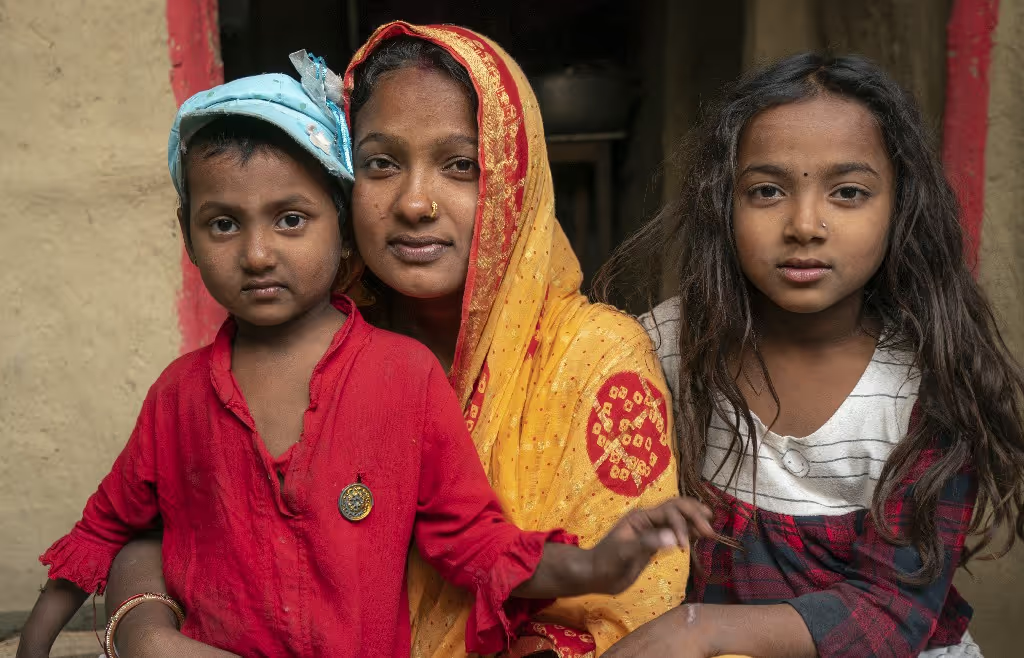
In Mahottari District, Nepal, 27-year-old Rakhi Mandal does her daily house chores and remembers expecting the usual ordeal: papers, queues, a long trip to the bank, and days of waiting. Her husband had lost his job during COVID-19; with no land or savings, the family of seven was stretching every meal. Cash aid processes are slow, fragmented and opaque through layers of bureaucracy, and Rakhi braced for another lost day. Instead, she received a voice message with information on her phone. She walked to the ward office, a one time password arrived on her phone and within minutes, she held the grant in her hand.
This was Rahat, a blockchain cash-transfer platform built by Rumsan with funding from UNICEF. Tested in early 2023, it transformed entitlements into secure, traceable tokens that could be redeemed locally, reducing delays, hidden costs and restoring dignity.
Slow aid and hidden barriers
For years, cash assistance in Nepal moved slowly. Registration, verification, approvals, disbursement, cash-out – each step added time and intermediaries. In past cash transfer programs, registration to disbursement could take up to a week, with beneficiaries typically able to claim assistance only a few days after receiving vouchers. In practice, families still spent hours traveling to distant counters, waiting in queues, producing paperwork and explaining their needs – costly in money, time and dignity.
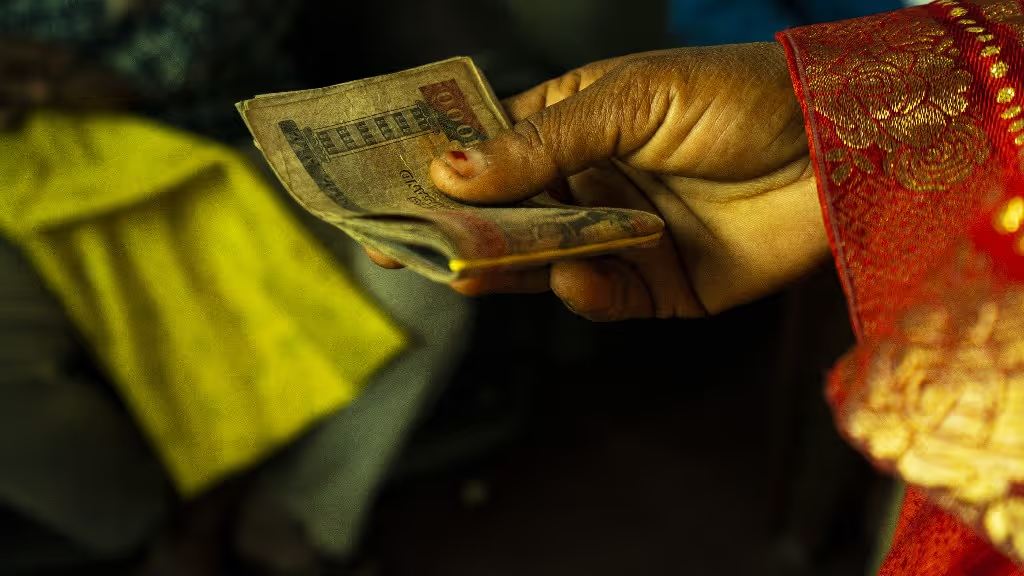
The system also bled inefficiency. Funds passed through multiple hands – donors, government tiers, financial providers – making reconciliation slow and gaps or overlaps hard to spot. And “digital” didn’t guarantee access; not every intended recipient had a bank account, a smartphone or reliable connectivity. During COVID-19 lockdowns, these weaknesses became acute. Newly vulnerable households like Rakhi waited while support inched forward, often arriving too late to be most useful.
Enter Rahat: What changed for people and systems?
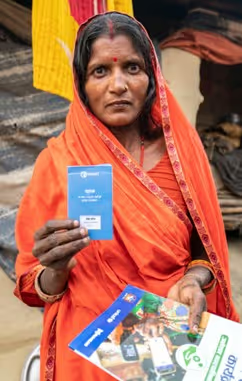
Rahat – “relief” in Nepali – was built by Rumsan with support from UNICEF’s Innovation Fund to streamline cash and voucher assistance in Jaleshwor, Mahottari. Instead of pushing money through layers of paperwork, Rahat turned each family’s entitlement into a secure digital token recorded on an Ethereum-based ledger.
Here’s how the flow works, without the paper chase. UNICEF transfers tokenized funds to the municipality on a shared ledger. Each eligible household is onboarded with a phone number or a printed QR card and receives a tokenized voucher for its grant. On distribution day, ward staff (or an authorized vendor) scan the OTP or QR in a simple app, hand over the cash, and the transfer is logged instantly. Every hop – from UNICEF to municipality to ward to recipient – is visible to authorized actors, cutting intermediaries, speeding reconciliation and reducing opportunities for error. Families without phones still use the QR card option; the backbone remains the same.
Why blockchain? Because an immutable, shared record creates a single source of truth across agencies and providers, and makes audits straightforward. Transactions don’t need to be reconciled days later – they’re already there, time-stamped. “We started with Ethereum (an EVM-based model) for the functionality and the core value of blockchain on transparency and accountability,” says Rumee Singh, Rumsan’s co-founder.
Smart contracts add the next layer. They enforce basic rules (only registered beneficiaries can redeem) and, in flood-prone areas, can trigger anticipatory cash. When river levels cross agreed thresholds, alerts go out and funds unlock automatically. In an emergency, those saved hours matter.
Verifying impact
In 2023, UNICEF Nepal commissioned Progress Inc. to independently assess Rahat. The study applied OECD DAC criteria – relevance, effectiveness, efficiency, sustainability – and used mixed methods: a survey of 327 households, focus group discussions (including women-only groups), key informant interviews with local officials, UNICEF, and Rumsan, plus document and platform-log review. To capture changes beyond preset metrics, the team also used Outcome Harvesting, gathering and verifying stories of intended and unintended outcomes. The evaluation was both summative (did it work?) and formative (how to improve and scale).
By triangulating user reports with on-ledger timestamps, the evaluation confirmed the core promises – faster delivery, accessible redemption and tangible empowerment – while flagging operational refinements. Crucially, because the validation came from an external party, it unlocked institutional buy-in; what began as a pilot became something leadership could champion, catalyzing plans for an anticipatory-action rollout. As UNICEF’s Venture Fund put it, independent evidence made the time savings and impact legible, and actionable.
Results: Faster, fairer, more empowering aid
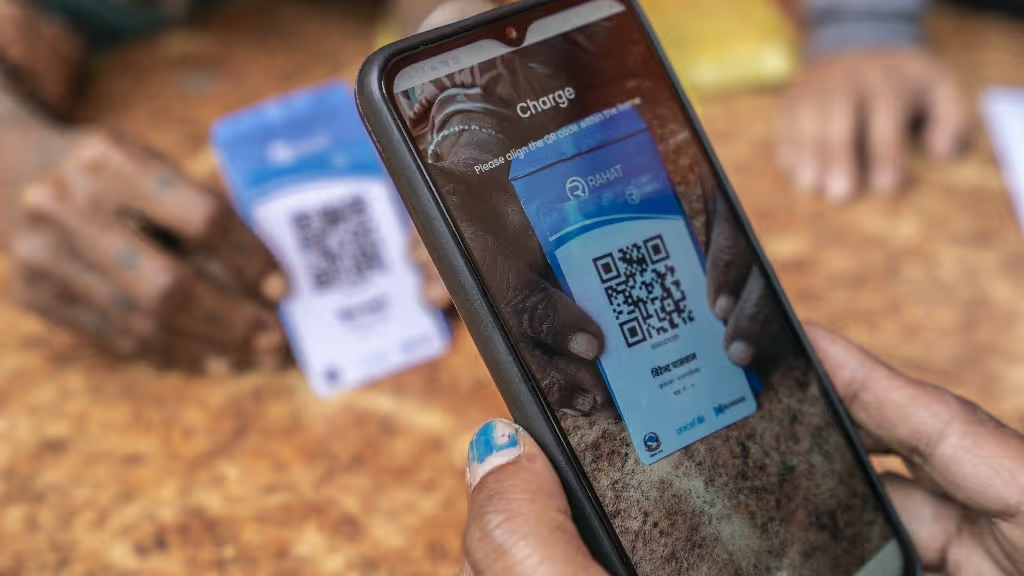
Even as a modest pilot, Rahat delivered measurable gains. What once took weeks happened in days – or minutes at cash-out. Once registered, households received disbursements within 24 hours. Real-time reconciliation removed spreadsheet bottlenecks, and the dashboard simplified monitoring; local officials noted that, after setup, operating costs could be lower than traditional methods (a full cost analysis is still pending).
- For families, the experience was straightforward. 95.7% of surveyed households had a mobile phone, and those without used printed QR cards. People weren’t stuck in lines, and the one-time-password step was handled without fuss. Satisfaction was high and complaints were rare.
- The biggest shift was agency. By sending cash straight to primary caregivers, most often mothers, the program put everyday decisions back where they belong. In women’s groups, participants talked about choosing food, medicine, and school needs first. Many described feeling more in control than before.
- Just as important, flexibility kept the door open. While 94.8% of respondents had bank accounts, only 82.6% chose bank payout; many preferred the ward office for proximity and lower travel costs. Rahat didn’t force a single channel; it supported several, while recording every handover on the same shared ledger. That meant people without the “right” device or account still got through.
- Taken together, the pilot channeled funds quickly to poor households (SDG 1, 2), strengthened women’s control over resources (SDG 5), and showcased an open, interoperable model built through multi-stakeholder partnership (SDG 9, 17). It wasn’t just faster – it was fairer, easier to use and demonstrably more empowering.
How we know the results hold up
On-ledger visibility: Every handover was captured on a tamper-evident ledger shared with officials and auditors, turning reconciliation into a live process and pushing off-chain banking steps to move faster.
Independent check: Progress Inc. (2023) matched ledger timestamps to cash-in-hand and beneficiary reports; the only notable gap – missed SMS or Voice instructions – was solved through ward-level outreach.
Lessons learned and challenges
Pilots surface what tech can do – and what it can’t do alone. Rahat worked because the build respected policy, people and plumbing. Here’s what to carry forward:
- Policy alignment (compliance first, then scale)
Rahat operated on a permissioned Ethereum network (Hyperledger Besu, PoA) because public crypto networks are not allowed in Nepal. The setup met compliance and kept energy use low. A consequence surfaced by the pilot: future expansion will hinge on interoperability if regulations change.
- Stakeholder understanding
Early hesitations from some officials reflected limited familiarity with blockchain. Orientation sessions and live dashboard demonstrations improved confidence and shifted perceptions from risk to utility.
- Operational integration
Several steps – beneficiary data hygiene and bank coordination for direct deposits – sat outside the chain and created parallel email-based reconciliations. The evaluation pointed to tighter integration with banking systems and links to digital public infrastructure (national ID, payments) to reduce manual handoffs.
- Human-centered delivery
A small share of beneficiaries missed SMS instructions at first; ward representatives resolved this through in-person outreach. Rahat team also introduced localized voice messaging. Designing for low literacy (e.g., voice/IVR, simple visuals) would further reduce friction. Targeting primary caregivers, often women, aligned with the empowerment outcomes reported in focus groups.
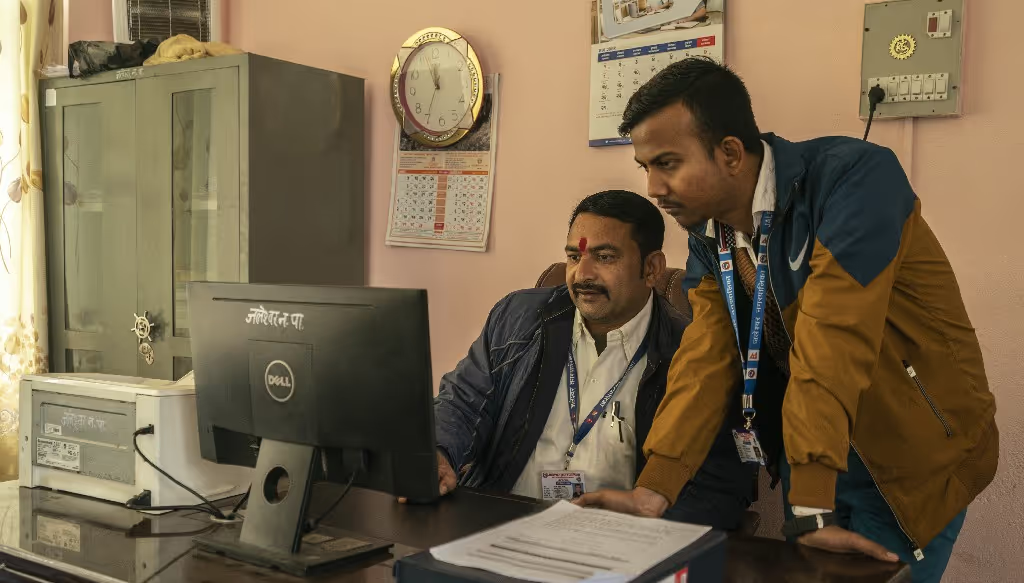
Blockchain provided verifiable, real-time records; policy alignment enabled operation; the human layer ensured last-mile inclusion; and system plumbing determined how much of the process could be automated end-to-end.
Scaling and the road ahead
In 2024, Rumsan and partners tested the anticipatory cash module with the Danish Red Cross, GSMA Innovation Fund and Mercy Corps Ventures in flood-prone districts, linking pre-agreed triggers to river levels and early-warning systems. UNICEF Nepal is now preparing to build on this approach, demonstrating that the same backbone can support both post-disaster relief and pre-emptive safety nets.
Scale will rely on fit and affordability as much as code. Rahat is open source and recognized as a Digital Public Good, lowering licensing barriers for governments and NGOs. Country offices can adopt it as a managed service or embed it within national social protection systems, integrating with ID and payment rails to retire manual handoffs. Interest extends beyond a single municipality; similar CVA pilots are being explored in other UNICEF program countries, with Nepal offering the reference implementation.
Functionally, the platform can go wider than cash. The same token mechanism can deliver in-kind support – such as digital vouchers for water and sanitation kits – or pay for defined services, with the same traceability and speed. Looking ahead, links to climate finance or parametric insurance could push early payouts even further upstream, where they prevent losses rather than only smoothing recovery.
What began as an emergency response in Mahottari has become a workable blueprint. Independent evaluation verified the core promises – speed, access, empowerment – while the ledger provided a living audit trail. The principles that mattered most for families like Rakhi’s were simple: transparent flows, fewer hurdles and agency at the edge. With anticipatory action bringing the timeline forward, and with integrations making the journey smoother, Rahat points to an aid system where help arrives when it is needed – not weeks later, but in minutes.