How the Building Blocks blockchain network is transforming humanitarian aid

In humanitarian emergency contexts, millions of people rely on lifesaving assistance delivered by a multitude of agencies that rush to help. In Ukraine alone, more than 600 organizations were active at one point, making it difficult, if not unfeasible to get everyone to use one system or process. This over-fragmentation can lead to duplicated payments for some households, unintentional exclusion for others, slow reconciliation and avoidable financial cost, which could help provide more aid.
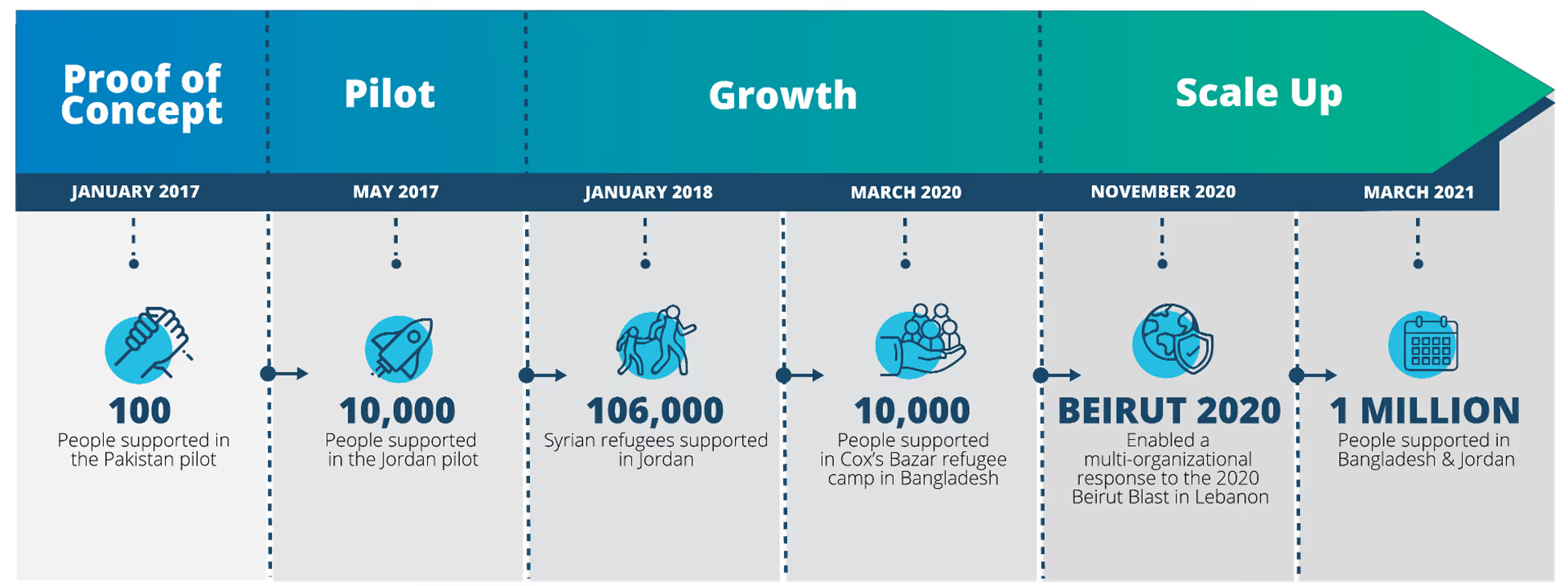
In 2017, faced with growing needs in refugee camps and a mandate to do more with limited funds, innovators from the United Nations World Food Programme (WFP) asked: Could blockchain technology make delivering assistance faster and more efficient? The idea was then put to the test in early pilots – first in a small proof of concept in Pakistan, then in refugee camps in Jordan. The Jordan pilot involved 10,000 Syrian refugees in Azraq camp using iris scan authentication to access a blockchain-based account to purchase food. It worked! Families received their food entitlements seamlessly, and WFP avoided hefty bank fees by settling transactions on its own blockchain system. This was the birth of Building Blocks.
Solving key humanitarian challenges: A new way to deliver assistance
Prior to Building Blocks, WFP and other agencies often relied on local banks, paper vouchers or separate digital systems to distribute cash and food assistance. This approach had several pain points:
- In some countries, transferring cash through banks or money agents incurred significant fees and could be slow. During crises, every dollar and every hour counts.
- Multiple organizations might be assisting the same community without a unified system, leading to unintended overlap (some families accidentally receiving aid twice) or gaps (some families receiving less than others).
- Without a common platform, it was hard to share data on who received what assistance, making coordination difficult.
- Physical tokens or vouchers can be lost or stolen, and centralized databases can be susceptible to infrastructure failures, typically addressed through technical safeguards like encryption, backups, and disaster recovery. Decentralized systems offer a fundamentally different resilience model; by distributing data and control across multiple nodes, they reduce single points of failure and enhance accessibility even in adverse conditions, providing stronger guarantees of continuity, transparency and user autonomy, especially in environments where trust and infrastructure are limited.
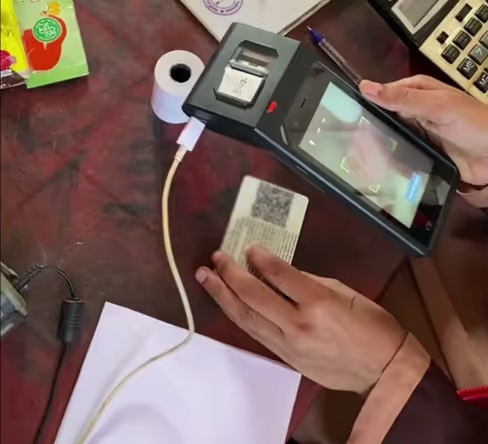
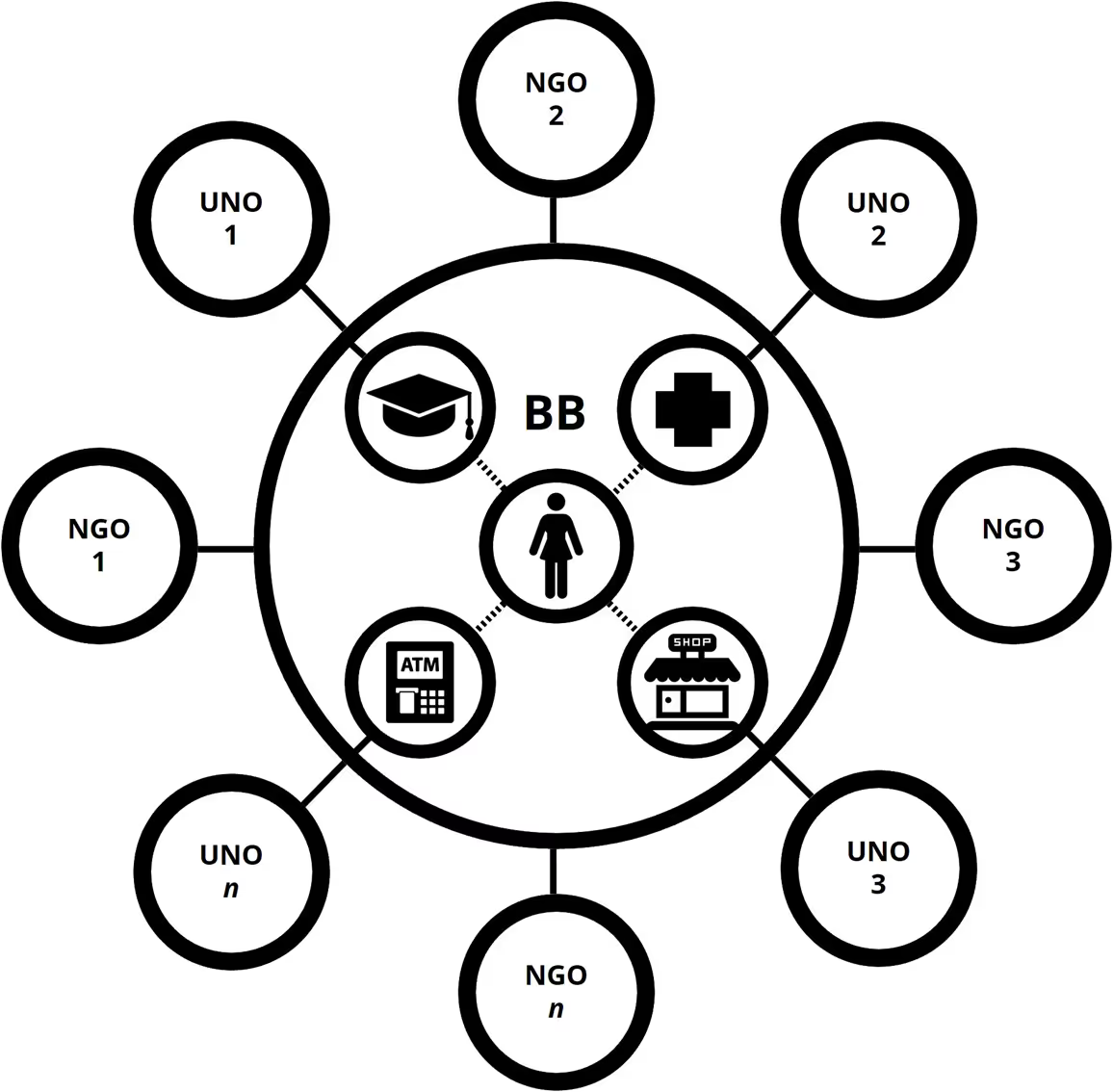
Blockchain technology offered a compelling solution to many of these issues. Building Blocks was created as a private, permissioned blockchain network connecting various humanitarian organizations. Unlike public cryptocurrencies, this blockchain is private to trusted aid agencies who manage assistance information on behalf of affected communities. Each family or individual has a digital account secured by the blockchain, which can be accessed with biometric ID or other secure methods. Multiple organizations can channel support to the same account, giving a complete, coordinated picture of assistance.
- For refugees and displaced people, aid entitlements can be unified and accessible in one place. Multiple cards or accounts are no longer required; everything is managed securely under one system.
- For aid agencies, assistance can be coordinated and distributed without ever sharing personal details. Agencies can see if someone is already receiving assistance and avoid unintended overlap, thanks to privacy-by-design features, such as encrypted identifiers and secure transaction codes.
Using blockchain has several advantages. It removes the need for costly third-party financial intermediaries, since value transactions can be recorded and verified on the shared ledger. It also creates an immutable audit trail – every transaction or transfer is logged and cannot be altered. If an organization loads US$50 of food assistance to a refugee’s account and the refugee spends US$10 at a local shop, both events are recorded on Building Blocks. Any network member serving that refugee can instantly see the updated balance and know exactly what assistance has been delivered and redeemed. This real-time transparency helps prevent both errors and fraud while enabling rapid troubleshooting – if there’s an issue with a transaction, staff on the ground can detect and resolve it on the spot.
Collaboration on an unprecedented scale
Humanitarian assistance often involves many players – UN agencies, government donors, international NGOs, local charities – each with their own systems. Building Blocks introduces a neutral playing field powered by blockchain where all participants are equal stakeholders. WFP initially built and hosted the original system, open to other humanitarian organizations under a cooperative model as 100 percent equal co-owners, co-operators and co-governors of the humanitarian blockchain network.
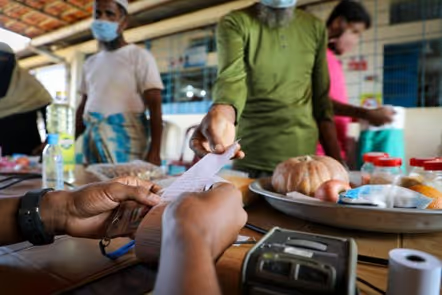
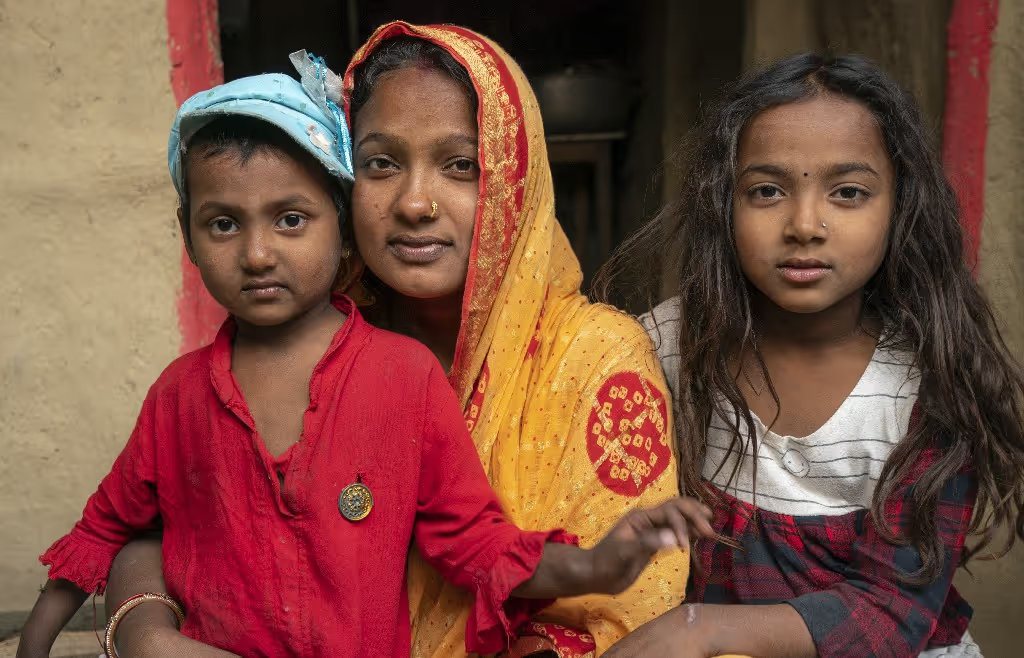
By 2019, UN Women joined the network to distribute cash to women participating in skills training in refugee camps. Building Blocks was no longer just a WFP platform, but a shared network. In the Bangladesh Rohingya refugee response, additional agencies came on board to use the service. UNICEF used it to provide soap to Rohingya families, and for the urban poor in Dhaka, UNFPA piloted enabling access to hygiene products for women and girls, alongside WFP’s food assistance. All these could be accessed by affected communities through one interface, as one combined assistance package – each family’s total aid could be tracked and kept within agreed limits to avoid some getting double rations while others missed out.
In Ukraine, over 80 Cash Working Group and Food Security & Livelihoods Cluster partners use Building Blocks for the proactive prevention of unintended assistance overlap, which was piloted in Lebanon after the Beirut blast and scaled in Ukraine in May 2022.
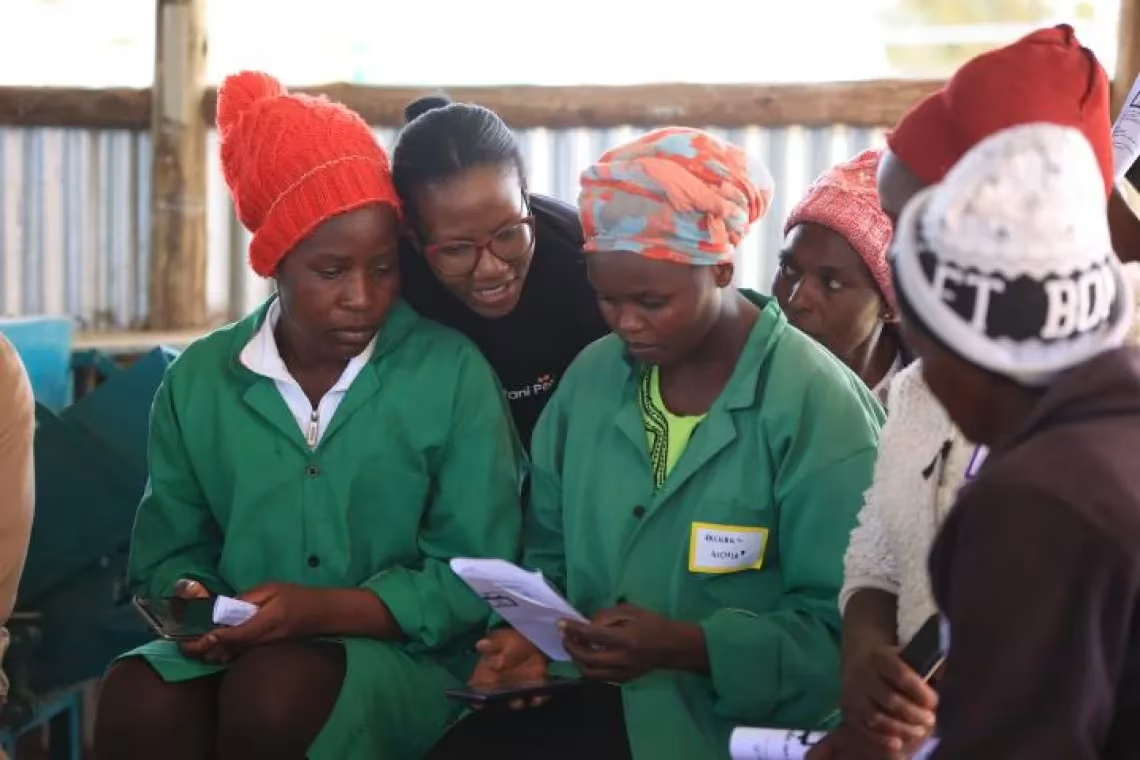
The collaborative model is reinforced by governance. Agencies that become full members of the Building Blocks network participate in joint decision-making about the platform’s rules and upgrades. There is no single “owner”; every full member organization has an equal say in governance. In some countries, WFP has offered Building Blocks as a free ‘software as a service’ via the local cash coordination groups and coordination clusters, so even organizations that are not formally part of the global network can benefit from it. This inclusive approach has lowered barriers for smaller NGOs to join large operations since they don’t need to invest in building their own system – they can just plug into Building Blocks.
“The Building Blocks project continuously seeks organizations interested in joining as full network members, to co-own, co-operate and co-govern, and harness the exciting potential of this humanitarian blockchain network.” Jessica Stanford, Global Project Manager for Building Blocks.
Impact by the numbers
After several years in action, Building Blocks has accumulated an impressive record of impact. Here are some highlights of what this blockchain-based approach has achieved:
- Humanitarian Reach
As of 2025, Building Blocks has supported around six million people in crisis-affected countries. This includes over one million refugees in Jordan and Bangladesh who use it for food and cash assistance every month, and millions more reached through emergency responses in Ukraine, Lebanon, Syria and Palestine.
- Assistance Delivered
More than US$760 million in assistance has been transferred through the platform to date, equating to > 40 million individual beneficiary redemption transactions. Each dollar is recorded and traceable, giving confidence to donors that their contributions are accounted for.
- Cost Efficiency
By eliminating bank intermediaries, Building Blocks had saved over US$3.5 million in transaction fees for WFP by 2023. These savings have been redirected to fund additional rations and support more families. Furthermore, the collaborative prevention of unintended aid overlap, estimated at US$270 million in Ukraine up to 2025, means donor money stretches further, with fairer outcomes.
- Faster Response
The ability to deploy quickly has been proven. In Lebanon and Ukraine, a Building Blocks instance was set up within weeks. In new emergencies like the COVID-19 pandemic or sudden displacements, the platform showed it can be adapted and scaled on short notice, since much of the infrastructure is virtual, configurable and reusable.
- Scalability
Technically, the system has demonstrated it can handle high volumes. It runs on a private Ethereum-based blockchain (originally using Parity/OpenEthereum), enabling millions of transactions per month with zero on-chain fees. Building Blocks continues to optimize the technology to ensure it meets growing demand without performance issues.

Lessons learned
Implementing a blockchain solution in humanitarian settings was not without challenges. Early on, WFP had to invest in capacity building – training staff and partners on how to use the system, and explaining to beneficiaries how their new digital accounts worked. There were also technological hurdles, such as ensuring reliable connectivity in remote camps and integrating the platform with biometric scanners and point-of-sale devices. Over time, these issues were largely overcome with pragmatic solutions.
Another challenge was governance and expansion, as getting multiple organizations to trust a new system required intensive advocacy and transparent governance frameworks. Understanding the importance of neutrality – it established that any agency joining as a full member co-owns the platform’s direction, preventing dominance by one entity. The project also highlighted the need for data protection in the age of blockchain. Strict measures, such as hashing personal data off-chain and only using unique tokens on-chain, were implemented to comply with privacy laws and humanitarian principles.
These lessons have been invaluable for the UN and the wider humanitarian community. Building Blocks showed that partnership is as crucial as technology. A fancy platform amounts to little if agencies don’t agree to cooperate; conversely, when they do cooperate, even relatively new technology can yield major gains. As a practical lesson, WFP found that offering the platform as a shared service helped bring everyone on board and created a network effect. This collaborative ethos is now guiding other UN blockchain initiatives.
A blueprint for the future
Looking ahead, Building Blocks is inspiring broader adoption of blockchain in areas like identity management and supply chain tracking. Humanitarian agencies are exploring whether refugees could carry portable, self-sovereign digital identities to access services across borders – building on the kind of encrypted ID system that Building Blocks already uses for cash aid. There is also interest in how the technology can speed up disaster response, for example by rapidly setting up cash distribution in a new emergency with the click of a button.
In summary, Building Blocks stands as an impactful example of the United Nations harnessing cutting-edge technology for social good. For the millions of refugees and vulnerable families reached so far, it has made life a bit easier – whether by giving them the dignity of choice at the market, or by ensuring they aren’t left out of assistance. And for the aid sector, it offers a promising model for unity and efficiency in an era where needs are vast, and resources limited.
.avif)